RP 3A Avoiding Relapse Drift
How Relapse Happens
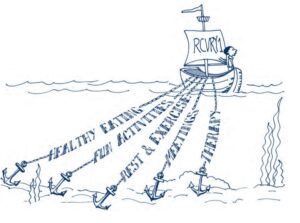
Relapse does not happen without warning, and it does not happen quickly. The gradual movement from abstinence to relapse can be subtle and easily explained away or denied. So a relapse often feels as if it happens suddenly. This slow movement away from abstinence can be compared to a ship gradually drifting away from where it was moored. The drifting movement can be so slow that you don’t even notice it.
Interrupting Relapse Drift
During recovery, people do specific things that keep them abstinent. These activities can be called “mooring lines.” People need to understand what they are doing to keep themselves abstinent. They need to list these mooring lines in a specific way so they are clear and measurable. These activities are the “ropes” that hold recovery in place and prevent relapse drift from happening without being noticed.
Maintaining Recovery
Use the Mooring Lines Recovery Chart (RP 3B) to list and track the things that are holding your recovery in place. Follow these guidelines when filling out the form:
● Identify four or five specific things that now are helping you stay abstinent (for example, working out for 20 minutes, three times a week).
● Include items such as exercise, therapist and group appointments, scheduling activities, 12-Step meetings, eating patterns.
● Do not list attitudes. They are not as easy to measure as behaviors.
● Note specific people or places that are known triggers and need to be avoided during recovery
You should complete your Mooring Lines Recovery Chart weekly. Place a checkmark next to each mooring line that you know is secure and record the date. When two or more items cannot be checked, it means that relapse drift is happening. Sometimes events interfere with your mooring lines. Emergencies and illnesses cannot be controlled. The mooring lines disappear. Many people relapse during these times. Use the chart to recognize when you are more likely to relapse, and decide what to do to keep this from happening. (After 5 weeks when the chart is full, transfer the list of mooring lines to a journal or pages 12 and 13 of your Client’s Treatment Companion, and continue to check your mooring lines.)